Monday, April 22, 2013

Week 14: Peter Pan (1953)

Have you read J.M. Barrie's book adaptation (it was a play first!) of Peter Pan? If the answer is no, you're doing it all wrong. I know, you're not a "reader" and honestly, I'm not either, but I'm trying, and this book has the power to truly captivate. Barrie has, perhaps, the most distinctive and magical voice of any writer I have ever encountered. For that reason alone, you should go buy the book and at least give it a try, because it's really quite phenomenal.

Now that that's out there, let's chat about Disney's take on Peter Pan. 


This was a rather exciting week for me, because it had easily been ten years since I last saw this gem in its entirety. I attempted to watch it a few years ago when I was at Disney World, but after a 14+ hour day of park going, who could blame me for falling asleep? In any case, I was so thrilled to know that this movie was coming up on my list that I went out and bought it a month ago. Yeah, I splurged for the Blu-Ray/DVD combo. Who do you think I am?

Oddly enough, with all the delays in my schedule, it so happened that I watched this movie the week after my 23rd birthday, the very same week that Boston, my current home, was attacked by the marathon bombers. These events made my viewing feel a little deeper than it probably would have been otherwise, because it's hard not to wish for a life of eternal youthful bliss when everything around you is completely out of control. So, for a time I was able to escape reality and that was nice and needed.

It's easy to see why Peter Pan is among Disney's most popular films, because it really has a lot going for it. It has fully-realized characters, a compelling plot, and the magic of Disney animation. The older I get, the more intrigued I am with the characters of Peter and Hook. There's something so interesting about their rivalry, because they share a decent number of similarities. They're the leaders of their respective groups, they invest a serious amount of time in trying to outdo the other, and they ultimately want to control the small island where they reside. Another thing they share, more so in the book is the desire for a mother figure. Ultimately, two such similar beings cannot coexist, because otherwise the rivalry wouldn't exist and, fittingly, this is where the plot comes in. Wendy, to Peter's mind, fits the bill of a motherly figure. She's old enough to understand the traditional duties of a mother, but not so old that she can't sense a great adventure. Hence, he invites her to Neverland and allows her two young brothers passage. As for the magic of Disney animation, there are plenty of memorable moments. I will always remember Peter, Wendy, John, and Michael flying around the nursery and over London to the tune of "You Can Fly." In that vein, who doesn't cry a little for Nana as she waves goodbye to the children?


I will say, however, that one area where the film comes up short (for me) is in its ability to really capture the voice Barrie gives to the story. I don't know whether the insertion of a narrative voice  throughout the whole film could have aided this shortcoming or not, but it's something that immediately came to my mind. The narrator only provides the opening introductions. On the other hand, I have seen a few film adaptations of Peter Pan and I don't think I'm biased in saying that this one comes the closest of them all. It may also be the most faithful of them all, too. But my concern is more for capturing Barrie's tone than it is for replicating his plot. That aside, I do love this movie and have since my childhood. Remember the story of how my mom went on to hide our copy of Peter Pan? Yep.


Above I mentioned one of my favorite moments from the film, when the children fly for the first time, and I wanted to talk about a couple of others that I've also enjoyed all these years. As a kid, I always wanted to fly in the clouds based on the scene where Peter and the children arrive in Neverland only to be attacked by Hook and his men with a canon. That always seemed like it had the potential to be a great game, albeit dangerous. Then there's Smee accidentally shaving the seagull. Who thought to add that scene? It's so ridiculous and perfect. I love it as much today as I ever have. And how cool is the animation in the scene where Tinkerbell hides behind a leaf as Peter scolds her for not helping Wendy? Lastly, I have a fondness for Wendy's bedtime story that she tells as she cleans off Michael's cheeks and talks to him about their mother. I will say that in the book (I'm that person, ugh), she, too, starts to forget their mother and it's a very interesting turn for her character that Disney might have been able to bring out.


Before I wrap up, let me take a moment to share some interesting facts about this movie. First of all, three cast members from Alice in Wonderland were brought back for this film to voice Wendy, Smee, and Mrs. Darling, they previously played Alice, the White Rabbit, and Alice's sister, respectively. Initially, Disney wanted to make this as his second animated film, which, I know, sounds like a repeated fact, because I said it about Bambi, too. But here's how it really went, Walt Disney wanted to make Peter Pan his follow up to Snow White, but couldn't get the rights, so he turned his attention to Bambi, which got held up and ultimately became the fifth Disney animated release. Disney did, obviously, earn the rights to Peter Pan, but sat on them through the 1940's as he attempted to find a version of the story that he wanted to tell. Finally, this was the last film to be worked on by all nine of "Disney's Nine Old Men," a crew that had started work together on Snow White. Some, of course, stayed on and worked on future released, but this was their last collective work. Lastly, Disney considered having the opening of the film be about Peter's backstory, but decided against it. Good thing, because there's no way he could have compared to Peter and the Starcatcher. Oh... which reminds me, though no film has aptly captured Barrie's voice, Peter and the Starcatcher, a play, certainly has. Ah, yes, the magic of theatre.


Though I've always appreciated Peter Pan, I've grown to enjoy it more and more with time, especially after reading the book and seeing some of the characters pop up on Once Upon a Time. I even dressed as Captain Hook from Once Upon a Time for Halloween this year. Plus, there's also that part about never having to grow up and I've never wished that more than when I had to actually start supporting myself. Overrated.


 Next week: Lady and the Tramp.

Wednesday, April 17, 2013

Week 13: Alice in Wonderland (1951)

It's amazing to me that by the time I reached Cinderella and Alice in Wonderland, these movies stopped feeling "dated." In spite of having been made over six decades ago, the (restored) animation looks as good as anything Disney put out in the 1990's, which is my gold standard.

I mentioned a few posts ago that I was set designing a production of Alice in Wonderland and that that process had thrown this whole operation off the tracks. Well, six weeks (seven?) later I am still behind, so I'm gonna chalk it up to a character flaw. I also promised photographs from the production - and I have a few - but I cannot yet deliver the full-out production photos as I am still waiting to receive them from a friend. More on those photos at the end.

Though I remember Alice from my childhood, it's not a movie that I'm incredibly familiar with nor - please don't throw stones! - frond of and that probably has a lot to do with the fact that it's not my mom's favorite movie. We owned a great many of what I now know as the "Disney Classics," but we didn't own them all, because my mom figured that she didn't want to be overexposed to the movies she didn't like. In fairness, my brothers and I were known to watch a few movies, namely Peter Pan and The Little Mermaid, on a daily basis for weeks at a time, so the logic was rather ingenious. Of course, her wisdom was limitless and, for a stretch, certain movies would go mysteriously "missing" until the craze had worn off. Moms are just smart like that.


I suppose a more legitimate reason for having not been a major Alice fan (in case I proved nothing to you with the above digression about my mother) is the narrative. It's all about story, again. Having experienced other tellings of Alice, I can honestly say that Disney's take is not my favorite. Please, don't get me started on Tim Burton's version! While the story is befuddling enough on its own, Disney is not able to make enough sense of it to create near as cohesive of a work as others have. This is where I mention that the version of the show I set designed, written by Eva Le Gallienne and Florida Friebus is my favorite adaptation out there. Also, FYI, I have never read the source material. It's worth mentioning that Disney attempts to do is make a singular film based on Alice in Wonderland, while pulling in elements from Through the Looking Glass, which kind of confuses things. And damn if that oyster scene doesn't still make my head spin. What is that about, really? In the end, the narrative of Disney's Alice in Wonderland harkens back to the company's earlier package films, which suffer from miniature arcs as opposed to an overaching story arc. Maybe if the idea of the Queen of Hearts was introduced sooner and she was a presence that was felt throughout the story my opinion would be higher, but it is what it is. 

Similarly, Alice just isn't one of the more compelling heroines Disney has given us. That's not to say there's anything necessarily wrong with her, it's just that her driving force is boredom brought on by school lessons. With Cinderella we have a young woman hoping to avoid a terrible fate brought on by an evil stepmother, Aladdin is a poor beggar just trying to scrape by, and Belle is trapped by the circumstances of her small provincial (and gossipy) town. Maybe it's just apples and oranges. Maybe not. More than that her motivations are a bit strange. It has always felt odd to me that she followed the White Rabbit, who never showed her much interest or attention to begin with. And then she has a lot of emotional breakdowns! I don't doubt that my growing experience with kids has affected my negative reaction to her tears. 


At the risk of becoming a whiner myself, it's time to discuss the good. I'm not the only one who loves the scene with the flowers, right? I think of all the strange encounters Alice has in this movie, this one stands above the rest. It's visually striking and it's musical. For me, it has the magic Disney touch, because it feels very unique. The moment when Alice is falling into Wonderland is pretty great, too. I also have to mention that while the Queen of Hearts is not nearly as prominent in the story as she could be, she will always be my standard of what that character should be and, I think, is hard to get right. So, props to Disney. 

Those are my thoughts on the film (I guess there weren't a whole lot, or I wrote this blog too long after having watched the movie). Next week comes Peter Pan, who has been enjoying a resurgence in my mind as of late.

Finally, if you're curious to see how I envisioned Alice, here are a few snapshots of the process to tide you over!

The whole process of designing started in December, but it was not until late February that actual construction and painting began. Ideally, building should have started much sooner, but there were budget issues. What can I say? It's hard to design an inexpensive show! And we only had $800, which was crazy. One of the first things we painted were some pre-existing black rehearsal cubes. Three sides on each were painted as seen below, while the other three were made to look like dice. Seen in the picture is my friend, Nadav, who directed the show. Directors who help paint are my absolute favorite and Nadav's already pretty awesome to begin with.


Painting the stage, which was an insane task, started only six days before the show was set to open. Being that the set would have to be a unit set (meaning no major set changes), I decided to create a very elaborate floor design. Below, I am creating a charcoal outline on the stage based on an earlier sketch I had done.


Within the span of 24-hours the stage started to take shape, but it still had a long way to go! And that was before the periaktoi (seen beyond the stage) scraped large portions of the stage. Luckily, both issues were addressed... eventually!


The periaktoi were a huge undertaking. I had the crazy idea to paint a variety of different images on each of the six faces of the four periaktoi. For those of you doing the math, yes, that's 24 different faces to paint, each measuring 4'x6'. But I had a lot of help, because alums, actors, and production staff members alike chipped in. Below, my friend, Julia (left), and an actor from the show are helping to stencil the outline of an over-sized queen chess piece.


My friend, Cara, one of the aforementioned alums, came in to help me. Below, we celebrate the completion of what was to become the Queen of Hearts' rose trellis. It was an optical illusion at first, so we strategically placed some fake vines later. I have something of an obsession with plants on stage thanks to some work I did on a show called, Yerma.


In spite of innumerable setbacks and a generally insane set design, the show was ready to go on opening night. It only took an overnighter by my scenic charge, Zoe, and me. When we finally went home it was 9am... and snowing.  


The best part was that when all was said and done, the show actually turned a profit. And sold out two of its three performances. Bam.


Friday, March 29, 2013

Week 12: Cinderella (1950)

I'll admit that I have been so excited to get to this week's viewing that I bought the Diamond Edition of Cinderella on Blu-Ray and DVD almost three weeks ago. It was totally worth it. Plus, Best Buy was having a sale, so I picked up Peter Pan, too.

With Disney's 12th animated theatrical release, Cinderella, a new era begins. Gone are the days of experimentation and packaged cartoons. Apart from Snow White and Pinocchio, Cinderella is the only the third film (up to this point) to encapsulate my definition of a "classic" Disney film. That's not to say it's only the third movie I have legitimately enjoyed and if you don't believe me, read about Bambi!

So, what exactly is a "classic" Disney film? Well, that's something of a complicated question, but I'll do my best to describe what it means to me. First, "classics" must have a full-length story complete with conflict, intrigue, and compelling and realistic (enough) characters. Love Bambi as I do, the narrative is somewhat shaky and it took adulthood to truly appreciate the nature of its storytelling. To me, this is the only measure in which Bambi does not meet expectations. Second, the animation has to have a certain detail and beauty about it. There's nothing out there quite like the work Disney animators can create when they're at the top of their game. Dumbo, sadly, doesn't meet expectations in this category, which I understand was purely a money thing. Third, it's a gut feeling. My favorite Disney movies are the ones I grew up watching (or can now imagine myself having watched as a kid, Tangled, Princess and the Frog, and Wreck-it-Ralph for example). There needs to be a longing for simpler times. Honestly, it's the nostalgic feeling I get from Disney creations that really makes me love the characters, the movies, the parks, etc. as much as I do.

The story of a young woman being held back by circumstance, in this case an evil stepmother, is no doubt a relate-able one and could account for just one of many reasons that it has held up through the ages, aside from the three good reasons I gave above that is... Or, perhaps it's the film's ability to creating lasting images. I was struck throughout this viewing session by just how many sequences and moments I remembered quite vividly. There's the scene where Cinderella cleans the floor on hand and foot only for Lucifer to leave behind his dirty paw prints, Anastasia and Drizella ripping Cinderella's dress to shreds, Cinderella's mice being turned into horses and then back, the list goes on. Then again, I may have seen Cinderella more than the average person, but I'd like to think they're memorable either way. Let's put the theory to test, how many of you can recall the moment when the mice and birds are assembling Cinderella's dress for the ball? I'd guess most of you! You can see a screencap of the moment below.


As I mentioned back with Snow White, I took a course on fairy tales that allowed us to examine several different fairy tales across their many translations and Cinderella happened to be just one of them, so I have some familiarity with its origins and thus its variations. If I recall correctly, one has her father very much alive. But Disney chose to give Cinderella some companions, who helped to fill in the scope of her life and in some ways, their existence parallels her own. And parallel storytelling is always cool in my book. Cinderella, for all intents and purposes, is treated by her stepmother and stepsisters with the same amount of reverence as a mouse. Okay, maybe a little more than that. After all, Anastasia is none-too-pleased to discover a mouse under her teacup. The mice, though, do have a lot in common with our titular heroine. They, too, are constantly punished and chased about the house (in this case by Lucifer) and, from what we see, forced to do their own share of daily chores. So, for the duration of the film, Cinderella's story is intercut with adventures of the mice, namely Jack and Gus, which expands on the origin story to give the audience a broader view of life in the house. Plus, it shows us all of the really cool mouse-sized secret passages, photos of which I cannot find.

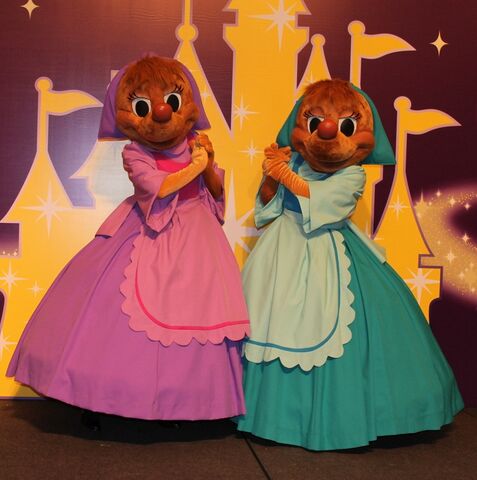
Quick sidebar regarding the mice, during my first Disney Parks outing at age 2, I was introduced to the mice from Cinderella and was apparently deathly afraid that I would be eaten. In my defense, just imagine looking up at the person holding you and seeing only its mouth. If I had a picture of the moment readily available, I would gladly display it to prove my point. However, judging by the below photo, it's quite obvious the mice are plotting evil. 


Speaking of building on its predecessors, in earlier scripts for the film, Prince Charming was supposed to have played a larger role in the story. This was to have included an opening sequence of him "hunting" a deer only to reveal that he and the deer were truly friends playing around. For one reason or another the scenes were inevitably cut and he was reduced to nearly the same token-prince-sized role as Snow White's. I, for one, would have liked to see him have a bigger role. First, it would have helped to see that he had a legitimate personality - hopefully, one unlike his seemingly crazy dad. Secondly, if we had seen him befriending a deer, well, at least we'd know he was less likely to judge Cinderella for talking to mice. Imagine that revelation! I can't help but wonder if this lead to Prince Phillip's role being as integral as it was in Sleeping Beauty. More on that later.


The last thing that I want to mention before drawing this blog to a close is that Once Upon a Time really needs to get back to Cinderella's origin story. The only morsel we've been given this season was a brief glimpse of poor Gus before he was torn apart. RIP Gus. We hardly knew ye. And I will say that watching this movie gave me plenty of great story ideas, so I'm pretty sure the people at Once can step up their game. Like what if all of Cinderella's mice were human servants that had been turned into mice as punishment by the evil stepmother? Also, remember that time Rumpelstiltskin made Cinderella's fairy godmother go poof? Yikes.


Anyway, it's great to be back to watching movies I consider "classic." As it happens Cinderella has always been one of my mom's two favorite Disney movies (you'll have to wait on the second title!) and, by association, one of mine.

Next week/still this week (technically I'm in week 13) I have Alice In Wonderland, which hopefully comes complete with images from my own imagining/set design of the tale.

Monday, March 25, 2013

Weeks 10 & 11: Melody Time (1948) and The Adventures of Ichabod and Mr. Toad (1949)

This week, I once again take a card from Walt Disney's deck and bring you a blog inspired by the "package films" of the studio's 1940's collection. That is to say, another blog featuring a double review. But fear not, much like the package films released in the 1940's gave way to bigger and better animated features, these double reviews are allowing me to close back in on my goal to watch one animated Disney film a week and once I have my normal blogging habits will resume.

The good news is that with each passing package film, Disney and his animators seem to be growing closer to establishing the whimsy and magic we all know and love. In fact, Melody Time starts with a segment, Once Upon a Wintertime, that makes up in story what it lacks in animation value (these things were made on the cheap). Whereas I complained in my previous blog about a stream of seemingly insignificant stories and characters in Make Mine Music and Fun and Fancy Free, the beginning of Melody Time instilled me with confidence. The Disney narrative I had always imagined was becoming clearer.

But life isn't that simple, because in the remaining six segments, I was up and down and back again. Yes, Disney and his animators were finding/rediscovering the magic of storytelling, but they weren't doing so on a completely consistent basis. Also, I am assuming, perhaps falsely that Disney was closely involved in these projects, but then again, maybe I'm wrong. Just know that I am choosing to pin the success and failure on him, because I know his name. Fun fact: I also wrote a report on him in seventh grade - didn't we all?

Speaking of strong starts, I felt similarly watching The Adventures of Ichabod and Mr. Toad, which is comprised of only two segments with - thankfully - very little time spent tying the two together (take heed Fun and Fancy Free - no disrespect to the cricket). The first feature is a retelling of The Wind in the Willows, and, arguably the better of the two. The follow-up is a take on The Legend of Sleepy Hollow, narrated by Bing Crosby, who could probably held my interested and attention through anything.

Before I get any deeper, though, I would like to the time to analyze the strengths and weaknesses of the films beginning with Melody Time, the older of the two releases.


As I mentioned Once Upon a Wintertime gives Melody Time a solid start, portraying the parallel romances of two young couples, one human, the other animal. The story has a certain simplicity, but there are little touches that make it compelling, such as the side-by-side comparison of young love and the male and female counterparts ultimately teaming up. The next segment, Bumble Boogie, is relatively forgettable and brief. But The Legend of Johnny Appleseed, the film's second longest piece at 17 minutes is a success. Perhaps it's the pairing of humans and animals that gives Disney its unique appeal, because in this segment Johnny is able to woo a pack of wild animals simply by treating a stray skunk with the same kindness one might afford to a dog. As a result, Johnny and the animals travel the United States sowing and planting apple seeds. Alas, it's not all sunshine and happiness, because for some strange reason, the ending shows us Johnny's eventual death (don't worry he goes to heaven and all that), which is the segment's one true flaw.

Then there's Little Toot, or the beginning of the end. It's here that Melody Time started to lose me. Little Toot is a rather dark tale about a small, yet troubled tugboat. At one point he causes his dad to crash a cruise ship and lose his job. What happened to escapism?! Anyway, the follow-up is about the seasons of trees, which I might say is just Bambi with Bambi cut out. So, about three minutes of nature's beauty as it endures the various seasons. Visually striking, but it feels like this belongs in another movie. Then, it's Donald Duck's five millionth appearance. I seriously had no idea he was in so many Disney films, poor Mickey. Naturally, he shares time with the other caballeros and there's a samba. Not that there's anything wrong with that.

Finally, it's the over-sized finale, Buffalo Bill, which feels too long for two reasons. First, it's the longest segment at 22 minutes and, second, it follows after three pretty brief animations. There's also a third reason that just came to my mind, it's the weakest story of the bunch and it involves live human narrators. Why?! Then, the color palette is too reddish-orange for my taste and the characters are just drawn in a very irregular-looking manner. The final straw was the glaring omission of my home state, New Mexico, see below. In the end, there were a lot of things working against this short, which tried to explain Buffalo Bill's entire history in a matter of minutes.


In the end, you win some, you lose some. Nevertheless, Melody Time, reveals Disney animation to be on a general upswing, so I'll accept.

The Adventures of Ichabod and Mr. Toad is the greater success, though, containing two longer-form animations that feel more Disney-produced than most of what had been seen in the "package film" era. What the adaptations of The Wind in the Willows and Sleepy Hollow had was the general "look" and story of a Disney film. Sure, the animation lacks the detail previously seen in Snow White or Bambi, but it's pretty on par with that of Dumbo, which was made on the cheap. The stories, though condensed down from a normal feature-length Disney movie, have definitive beginnings, middles, and ends, with plenty of time to establish necessary emotional beats.

More important, to me, than either of the above criteria is the characters. In comparison, this is where I would rank The Wind in the Willows higher than Sleepy Hollow as it is able to capture the essence of compelling characters far better. For most of Sleepy Hollow I was confused about who I was supposed to be rooting for and still kind of am. Ichabod was seemingly the "hero" of the story, yet in the end he didn't get the girl. Then, there was the fact that he seemed to use the women in the village to get meals. But he had the voice of Bing Crosby, so how could I not root for him in some way? Meanwhile, the characters in The Wind in the Willows were complicated, yet understandable. There's Toad, the likable heir too often wrapped up in some sort of mania. As an audience member I wanted him to ultimately succeed in spite of his flaws.

 
It's worth noting that I have zero experience with the texts of either The Wind in the Willows or Sleepy Hollow. And even though I know I saw this film as a child, I recall owning it, I remembered almost none of it, so there you go.

Oh, one last thing that I thought was kind of cool, is that at the beginning of The Adventures of Ichabod and Mr. Toad, the narrator asks, "If you were asked to chose the most fabulous character of English literature, who would it be?," before naming off the likes of Robin Hood, King Arthur, Oliver Twist, and Sherlock Holmes, all of whom have been given their own Disney adaptions. I have to wonder if Mr. Toad would feel cheated knowing he only got half of a feature-length film?

This week I have to catch up by watching Cinderella and then Alice in Wonderland, which got me into this mess of being behind!

Tuesday, March 19, 2013

Weeks 8 & 9: Make Mine Music (1945) and Fun and Fancy Free (1947)

I haven't forgotten about this blog! I'm back. 

Yes, I have fallen behind my own standards... But the good news is that I (and you as my reader) have not given up. A large chunk of my absence can be explained by a commitment I made to set design a production of Alice In Wonderland that was directed by a very close friend. Plus, as a Disney fan, how could I be expected to say no? As an apology, I promise to share my take on Alice, but not until the time is right (see Week 13). So, in the meantime, let's just agree that life is crazy and that sometimes finding even the tiniest slice of time is impossible, but we're all sorry.

Now, you might also feel ripped off knowing that I have combined two movies into a single blog entry. But aside from the fact that it does make my life easier to lump them together, there's actually good reason for them to be discussed side-by-side and that is they are remarkably similar in composition. Much like Fantasia, Sauldos Amigos, and The Three Caballeros, Make Mine Music and Fun and Fancy Free are "package films," or theatrical releases of collected cartoon shorts that are strung together in some sort of thematic way. With Make Mine Music little effort is made to really weave the stories together other than that they're simply stories told through song. Conversely, Fun and Fancy Free gives us narrator Jiminy Cricket to help us navigate the different stories. His (and the director's) job is significantly easier, though, because Fun and Fancy Free contains only two cartoon shorts to Make Mine Music's ten. For clarification's sake, Walt Disney only chose to forgo more traditional animated fare like Snow White, Pinocchio, or Dumbo, because many of his animators were tied up by WWII and he did not want to completely get away from theatrical releases. Essentially, he made the choice to work with what he had and what he had was a lot of unused short cartoons.

I'll be honest and say that Make Mine Music isn't oft remembered or mentioned, because there's not a lot to it. The problem with it being comprised of ten shorts and running at just 76 minutes is that none of the cartoons have a moment to breathe. Before the audience can even get used to the characters, they're gone. And they're not exactly recognizable characters. If the shorts revolved around well-known Disney or even fairy/folk tale characters, they might make more of an impact, but they're not. The only use of a well-known character (that I can think of) is a Peter and the Wolf segment, but the rest are original or fairly unknown. Additionally, the cartoons don't all end in the traditional "happily ever after" manner that we have come to expect from the average Disney feature. In one about a singing whale, the whale is ultimately killed under the suspicion that he swallowed multiple opera singers (he didn't).


Speaking of death, the general tone of these shorts is pretty violent. The first segment features dueling families who kill each other off in a gun battle. The above image shows them going to heaven (really?). I read that in more recent releases of Make Mine Music, attempts have been made to tone down the more violent portions of the original. Of course, I don't know which edit of the film I saw, but I'd certainly hope it was the original, because it got pretty dark! I'd hate to think how much darker it could've gotten - this is Disney, after all.

There's not much more to say, so I will sum it up by saying I'm thankful the film exists, because without it, who knows what might have become of Disney animation had an effort not been made to keep it running during the war?

As for Fun and Fancy Free, there was definitely a lot more thought put into the thematic organization of the film and its shorts, but it didn't make much of a difference to me. In fact, such an effort is made to establish Jiminy Cricket as the film's emcee that the shorts are almost lost among the clunky set up, which is probably as long as either short when added together. Worth noting is that there's some live action in the latter half of the film, live action that includes not one but two creepy puppets! And let's face it, Who Framed Roger Rabbit? and Rock-a-Doodle are the only movies I can think of that made cartoons and real people co-exist well.


The first short comes in the form of Bongo, in what I can only imagine is the continuation of Dumbo's life, only this time he's a bear. Essentially, Bongo is a poor, mistreated circus bear, who runs away into the wild and must adjust to "uncivilized" animals. In time, he meets a female bear and they fall in love, which apparently in "bear talk" is conveyed via slap (maybe not a super strong choice for a kid's film...). But there's a big bear who tries intervene steals away Bongo's girlfriend for a time. I'm sure you can guess the heroic ending. Then, there's a retelling of Jack and the Beanstalk featuring Mickey, Goofy, and Donald, which I had not only seen, but could get behind - familiar story told with recognizable characters, albeit in a condensed form. I might add, this short represented Walt Disney's final voice-over work as Mickey. The below image has somehow remained with me since the first time I saw Mickey and the Beanstalk as a kid (for whatever reason) and so I chose to share it.


Overall, two shorts do have a longer amount of time to establish themselves and their characters than was the case in Fun and Fancy Free, but in the end they're still shorts to me. I guess I require more time and depth in storytelling, just like Donald (above) wanted more to his sandwich. I just want to see one film when I sit down to watch a movie. But like I said before, I'm glad this movie gave way to more enjoyable films a little farther down the road.

Up next I have Melody Time and The Adventures of Ichabod and Mr. Toad, which may or may not get a joint blog. Time will tell!

Thanks for reading!

Monday, February 18, 2013

Week 7: The Three Caballeros (1944)

The Three Caballeros is the second Disney theatrical "package" film after Saludos Amigos. It's a collection of animated shorts loosely tied together. This time, Donald Duck is celebrating his birthday and receives a box filled with a variety of gifts that lead him on various journeys.

The first couple of segments teach Donald about his close relatives, birds, and one almost begins to think that this film will be an animated documentary about the various birds of our world. But then Jose Carioca returns to teach Donald a bit more about his Brazilian culture, parts of which include them dancing with live action dancers. It's rather odd to see the characters blending in with real people, but hey Who Framed Roger Rabbit made it work a few decades later, so there's that. Then, the gun-wielding (yep) Panchito Pistoles of Mexico joins in on the fun taking the trio on a Mexican excursion, though bender almost seems a more appropriate term. It's here that the wheels come off the track as the latter part of the movie becomes a flashy, nonsensical montage of Donald chasing after (human) women. Finally, the film ends with Donald still wanting of a woman, but angry with his friends who seemingly prevented him from reaching this goal.


In the end, the attempt on the part of the director to make sense of the various segments just feels too forced. The movie isn't really sure if it wants to be a bird documentary, a travelogue, or a strange film about the way Donald Duck exoticizes (I probably made that word up) women. Maybe if he had committed to just one of those ideas the whole thing would have played out better.


It's more than just the story that feels out of sync, though. The animation, likewise, is all over the place. Parts are imagined quite simplistically, while others are vibrant and flashy. The above image is from a segment of the film that is told through still photos that would appear to have been done in pastels. Again, random.

I'd also point to the strange characterization of Jose and Panchito. Jose smokes a cigar (at least he does in earlier releases of the film) for a great portion of the film, which was less controversial, if not all together acceptable back then, but still, he's the only one to do so and one of few non-villainous Disney characters in the canon to do as such. Panchito, on the other hand, carries a gun quite casually. If this film was trying to offer up any sort of good will to Latin America, I'm not sure it made the mark. As usual, portraying other cultures is full of problems and pitfalls.

It's not an especially interesting 72-minute film though the early segments are entertaining enough. The Three Caballeros is just another reminder that when Walt Disney Studios started out, it took it more than a few films to figure out what it did best. The movie hasn't left behind much of a mainstream legacy, but may have more popularity in Latin America. It did, however, produce a dark water ride at Epcot's World Showcase where park goers can take a "tour" of Mexico alongside Donald, Jose, and Panchito and, in my opinion, it's far more enjoyable as a 5-minute trip than it is as a feature length film.

Next week is Make Mine Music. Honestly, who has heard of this one?

Monday, February 11, 2013

Week 6: Saludos Amigos (1942)

Now that I have finally seen this movie I can understand why I have never seen it before. Saludos Amigos is not a traditional Disney animated film.

What Saludos Amigos essentially amounts to is a quick documentary about the Disney animators traveling to South America to capture the essence of life in another part of the world. Drawing on this venture (surprise pun), they create four short stories that aim to capture the essence of four South American regions: Lake Titicaca, Chile, Argentina, and Brazil. The runtime of each segment lasts no more than about ten minutes, with two to three minutes spent chronicling what unique qualities the animators found in each area. In all, Saludos Amigos runs 42 minutes and it's not really enough time to dig deep or to grow very attached to any of the ideas. It's purely surface level.

I remember discussing this film with my friend, who just so happens to come from Brazil, a couple of years ago. She spoke fondly of the film, having appreciated its commitment to her country, her continent, and its culture. By the way, in the film Brazil is represented with its own character, Jose Carioca, who I believe is based on a character from Brazilian folklore.

For me, the film wasn't nearly as appealing. I have always considered myself to be a story-first type of person. I like a narrative or character that I can get behind. Sometimes a familiar setting will draw me in, but that can only get me so far.

I wouldn't necessarily say that the film has a narrow appeal, but as one of few Disney films to be made more or less specifically about the culture of a few regions and not a long one at that, it hasn't maintained the popularity or name recognition of many of Disney's early works. Obviously, many Disney movies have found a way to introduce their audiences to different cultures and environments, but most do so in a secondary manner, with story serving as the conduit through which the audience is educated. Maybe someday soon we will have a new Disney animated film that has a South American backdrop, because it has certainly been a while.

In a way this movie serves as a reminder (much in the way that Fantasia did) that when Disney animation started out, it wasn't nearly as clear-cut or decisive as it is today. It makes sense, though, because when it began, there wasn't really a market for animated films. Everything they were doing was ground-breaking and new. Maybe if films of this nature had caught on, Disney would still be profiling various countries in a similar manner, but they didn't find quite as much success and over time they more or less ceased to exist. Today, new takes on classic fairy tales or other such stories seem to be the bread and butter of Disney.

But before I get back into that style of Disney film, I move onto The Three Caballeros, which this film set the stage for by introducing Jose Carioca to Donald Duck.